Denver, 1948
2650 Welton Street, listed in that year's Green Book under Denver taverns. The lounge filled the smaller south part of the ground floor, with live music; the grill was on the corner.
The lounge's postcard names its hosts, John Kigh and Quentin Harrington. The building's 1995 National Register file, drawn from residents' memories, says Black musicians who "were not welcome at white owned and managed hotels in the city" stayed at the Rossonian and played the lounge, and that it "welcomed a mixed clientele."
This room is a reconstruction. The booths, tables, chairs and what sits on them follow 1948 photographs of the lounge in the building's 1995 National Register file, used as reference and not shown here while we seek permission. The six porthole windows follow a photograph of the front, c.1945. The menu and the house sign carry the lounge's own words, from its menu and postcard at the Denver Public Library. The room's depth, its colors, the bar and the bandstand are our guesses. Switch on "Show sources" to see which is which.
The telephone booth
The menu prints two numbers: KEystone 9003 and TAbor 9493. In 1948 the first two letters of the exchange were dialed as digits: K and E sit on 5 and 3. Dial one of them.
·· ····
Numbers read off the lounge's menu, c.1950 (Denver Public Library). Letters on the dial follow the Bell System layout. You can also type the digits.
Welton Street, by the book
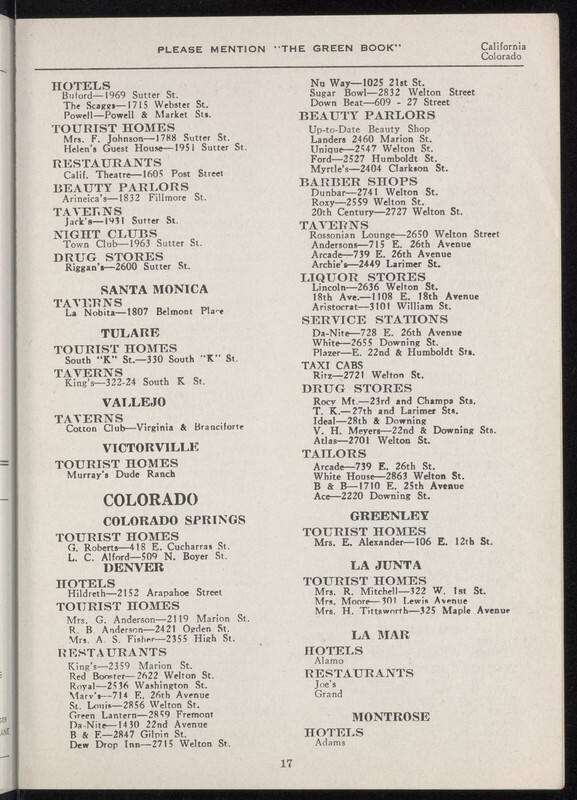
Every Welton Street listing on page 17 of the 1948 Green Book, at its own address. Point at a sign to read it.
Piano sound: Salamander Grand Piano by Alexander Holm, CC BY 3.0. These chords and bass lines are shapes Black musicians built and passed on; each lesson credits them. Boogie-woogie history: Carnegie Hall, Timeline of African American Music.
One note on every beat, four to the bar, walking through the chords of the same 12-bar blues. Beat one lands on the chord's root, the middle beats walk its notes, and beat four leans a half step into the next chord. Jazz historian Lewis Porter: walking means "one note on every pulse of a four-beat measure." Around 1930 the string bass took over that job from the tuba. The bassist most tied to walking is Walter Page, with the Blue Devils and then Count Basie, though Porter disputes that Page invented it.
Click the fingerboard where the dot is lit, or use the keys Z to M. Bass sound: University of Iowa Musical Instrument Samples (free to use without restrictions). Porter quote: Lewis Porter on Walter Page (Substack). The bass itself is our guess.
On the table
The book you carried in the car, open on their table, the Rossonian still circled in pencil. "Rossonian Lounge—2650 Welton Street," under Taverns. The same page lists the Hildreth on Arapahoe Street as Denver's hotel.

1963–64
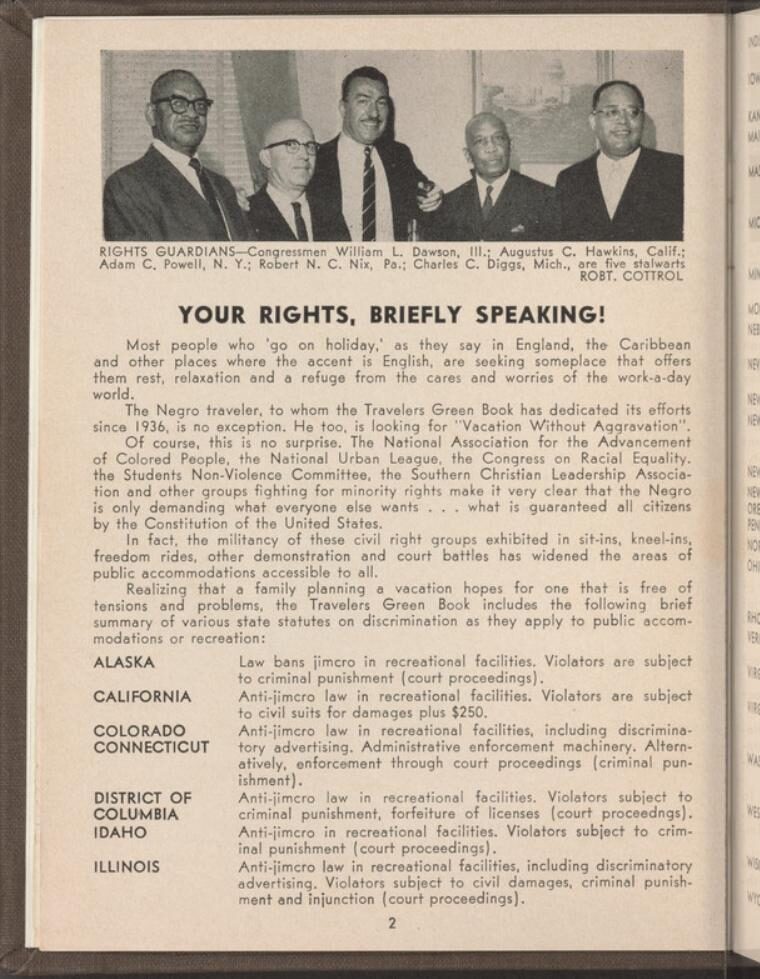
Fifteen years on, the book printed “Your Rights, Briefly Speaking!”: a state-by-state summary of anti-discrimination laws. It credited "the militancy" of the civil rights groups, shown in "sit-ins, kneel-ins, freedom rides," with widening the places open to all.

1948, page 1
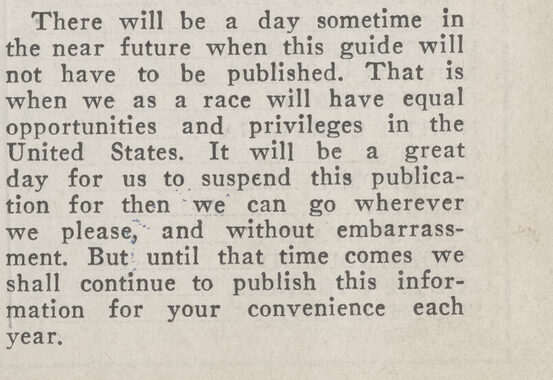
Back in the 1948 book you carried, Green's guide had already printed the day it was working toward.
And then, in Denver
The Rossonian's 1995 National Register file tells what came after. As Denver hotels opened their doors, "the necessity of the alternative lodging provided by the Rossonian lessened. The lounge drew fewer traveling big name musicians." As "real estate in Denver opened to minorities in the 1950s," Black families moved to other neighborhoods, "notably Park Hill," and "the black community centered in Five Points became more dispersed." The building "was sold for back taxes in 1960 without improvements and has remained under-utilized and poorly maintained until recent years," the file said in 1994, after a rehabilitation begun in 1991.
The road
Every listing in it was a real place that served Black travelers. When the doors opened, places like the Rossonian paid for it. This drive goes to three of them so far.